When You’re Wired Differently: Not Every Space Is for You
During a tumultuous 2025, writing was the one thing that helped me cope. I realized I needed to write every day. Whether I was working on novel chapters, poetry, or nonfiction, I made sure I was always engaged in a project.
The thing about writing is, I’m able to recharge my mental battery when it’s drained. It’s also a natural antidepressant. Whenever I’m feeling down, all it takes is a few hours of working on my novel, and I walk away from my desk inspired, forgetting what I was upset about in the first place.
At the beginning of this year, a creative writing course felt like the right next step for me. I hoped to connect with other writers. I also wanted to find a “ground zero” writing school for a series of courses I planned to take throughout the year.
Sharing my work wasn’t part of the plan for this class, mainly because the course description made it clear that workshopping wouldn’t be included.
The goal was simple. I was there to learn, and I did. The class offered a greater understanding of the elements and techniques behind writing short stories. Along the way, I discovered incredible stories by writers I had never read before. Even the homework felt rewarding, sparking new material and fresh ideas with each assignment.
But there was something I couldn’t figure out. I always felt horrible after class. I logged off feeling awkward, out of place, like I didn’t belong there.
I’m an introvert, so I knew an online writing course might be challenging. Still, I’ve been an introvert my entire life, and I’m no stranger to online meetings. As a licensed clinical professional counselor, I’ve attended many meetings and conferences, both in person and on Zoom, and I’ve never left a meeting feeling as bad as I did in this writing class.
There were only six sessions, thankfully. But looking back, I think what bothered me the most was how I showed up in those moments. I was writing like someone who didn’t have a clue, like I hadn’t been writing since the age of ten. My brain simply refused to work.
It would slip into a complete shutdown whenever it was time for a 10-minute writing exercise. I’d sit there staring at my monitor, reading the prompt repeatedly. Then I would glance at the clock as the minutes slipped away, then stare at the screen again. Thankfully, the instructor rarely called on me to share. Most of the time, I had only managed a single sentence by the end of those ten minutes.
During the third week of class, I knew I had made a mistake signing up. All of my motivation disappeared.
That same week, though, I came across a VICE article about one of my favorite lyricists, Andre 3000. One line in the article completely shifted my perspective. The writer explained that Andre 3000 isn’t “wired to craft a verse out of thin air,” emphasizing that the timing has to be right and that he needs to have something meaningful to say (Catlin, 2026).
Not wired.
That was the exact phrase I used when explaining my experience to my husband the week before. At that moment, everything made sense. I’m a slow-simmer writer. Sometimes I can read a prompt and write freely, but most of the time I need to sit with it. I need time to think before I create.
An example of this is when I took a 30 Tiny Stories class a month after the creative writing class. I reviewed the prompt in the morning and had the rest of the day to think about it. Then, in the evening, I wrote my story with much success!
Signing up for a 6-week online writing course wasn’t the best idea for me. It was too fast; I just couldn’t keep up. My brain doesn’t work that way.
Even in work meetings, it’s best if I let my thoughts marinate for a while before I respond to a question. I need time to process information.
When that realization hit, I wanted to leave the class, but I stuck it out because I had already paid for it. And ultimately, it was a great idea for me to challenge myself, to sit with my discomfort, and to try to write on the fly.
But more importantly, it taught me something valuable. Not every space is meant for me.
Writing a short story in ten minutes is not my gift. That gift belongs to someone else. I heard incredible stories from writers in that class who thrive in that kind of environment. I just…don’t.
So, here’s to celebrating the way my brain works. Here’s to recognizing that in some spaces I may struggle, while in others, I excel.
And maybe you’re wired differently, too. That’s not a bad thing. Just remember to place yourself in environments where your brain feels at ease, because that’s where you’re more likely to thrive.
I’ve come to accept that the best writing I’ll ever do will come the way it always has: In a quiet space, alone with my thoughts, and on my own time.
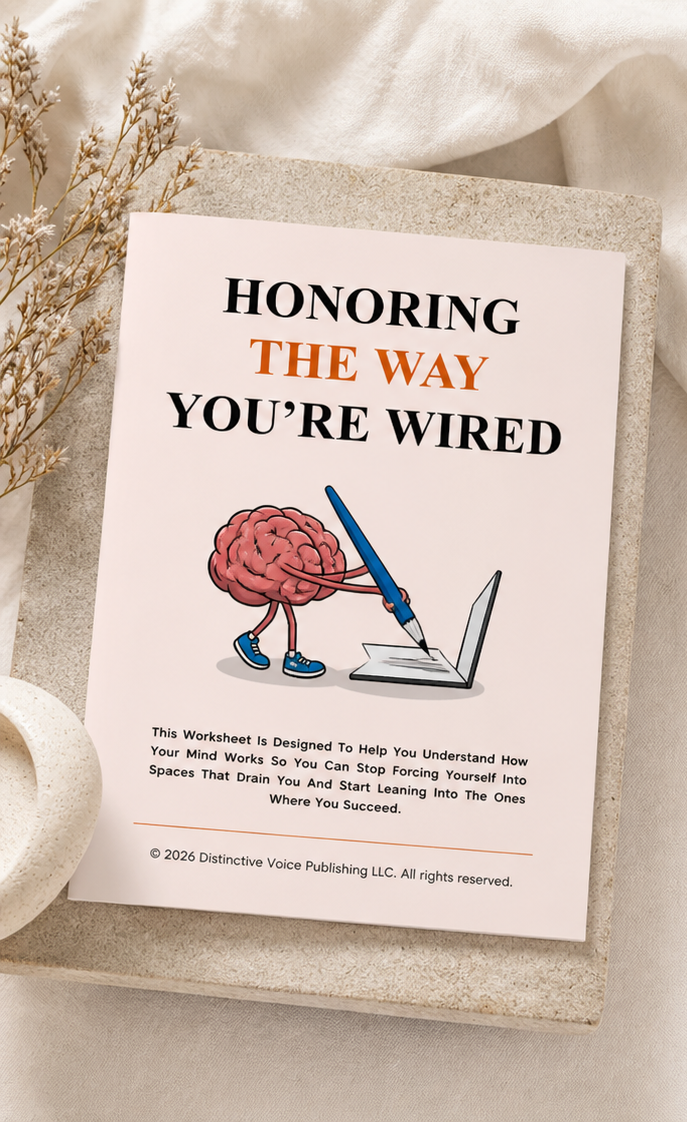
Honoring the Way You’re Wired is a worksheet designed to help you better understand how your mind naturally thinks, processes, and responds. Through thoughtful prompts, you’ll explore your natural rhythm, identify environments that drain or overwhelm you, and recognize the spaces where you truly thrive.
This worksheet also supports reframing self-judgment into self-compassion, helping you shift from “what’s wrong with me?” to “what works for me?” By the end, you’ll walk away with practical insights and small, meaningful changes you can make to align your life with how you’re naturally wired.
Source: Catlin, C. (2017, April 25). Andre 3000 breaks down how he chooses which songs to record guest verses. VICE Media. https://www.vice.com/en/article/andre-300
Photo by Resource Database on Unsplash